
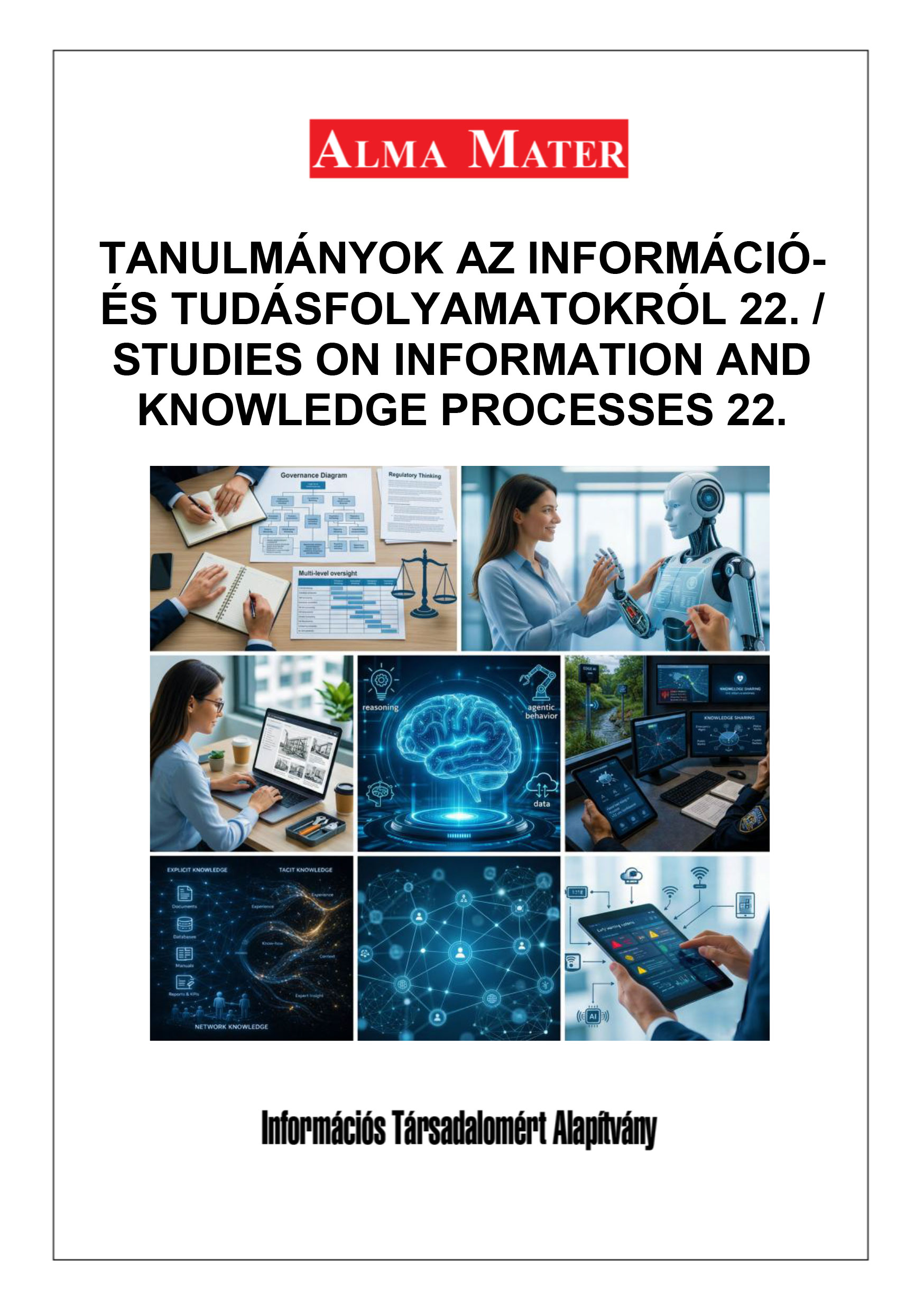
Cím:
Tanulmányok az információ- és tudásfolyamatokról 22. / Studies on Information and Knowledge Processes 22.
Kiadó:
Információs Társadalomért Alapítvány
Szerző: Kiss Ferenc (szerk.)
Kiadás éve: 2025. december
Oldalszám: 190
ISBN: 978-615-82082-9-1 (pdf)
ISSN: ISSN 1587-2386
DOI: https://doi.org/10.60030/ALMAMS.k202501bT9BiXAz Alma Mater sorozat 2001 óta az információ- és tudásmenedzsment első számú hazai tudományos publikációs fóruma, emellett a tudományterületek kapcsolódásának okán, illetve az alkotóműhelyekben meglévő keresztkompetenciák által lehetővé téve – jelentős, a nemzetközi szakmai közösségben is nagy figyelmet elérő tanulmánykötet sorozat.
-
- Cím:
- Knowledge governance of artificial intelligence: the first steps
- Írta:
- László Z. Karvalics
- Oldalszám:
- 1-16.
- Nyelve:
- Angol
- DOI:
- Governance of Artificial intelligence (AI governance) and knowledge management of artificial intelligence are well-known, widely discussed, popular terms with extensive technical and methodological literature. However, existing knowledge governance practices do not yet have to contend with the opportunities offered by artificial intelligence (AI for knowledge governance). Knowledge governance of AI, however, is an increasingly important yet undeservedly neglected issue. In this study, which is intended to stimulate discussion, I offer a definition of the concept of knowledge governance and place it in the context of fundamental issues related to artificial intelligence. I demonstrate that knowledge governance can be considered the strategic meta-level of all areas of AI development, while it also needs to support management and governance tasks by utilizing the results of knowledge sciences. Finally, using a four-level model of knowledge governance, I will highlight one or two pressing issues, whether it be global AI knowledge governance (macro level), that of nation states (meso level), that of companies and large organizations (micro level), or even that of individuals (nano level). I do so in the hope that this will spark an exciting dialogue on the subject.
-
- Cím:
- Trust and Adoption of AI in Business: Perceptions, Risks, and Solutions
- Írta:
- Levente Szabados, Adam Búza
- Oldalszám:
- 17-61.
- Nyelve:
- Angol
- DOI:
- Artificial intelligence (AI) is transforming business processes; however, trust remains a key factor in its adoption. Drawing on a survey of Central European professionals, we examine the relationship between AI use and trust, approaches to assessing AI reliability, and the role of different strategies in responsible deployment. The results highlight the importance of trust-enhancing tools and regulatory frameworks, which can support the responsible uptake of AI in the business environment.
-
- Cím:
- From Perceived Disadvantage to Competitive Advantage: Generative AI and the SME Opportunity
- Írta:
- Ottó Werschitz
- Oldalszám:
- 62-75.
- Nyelve:
- Angol
- DOI:
- Small and medium-sized enterprises (SMEs) across Europe are widely perceived as lagging behind large firms in the adoption of artificial intelligence (AI). This article argues that generative AI fundamentally reshapes this narrative. Drawing on practitioner experience and recent empirical insights, it shows that generative AI lowers long-standing barriers related to cost, expertise and access, while at the same time placing new emphasis on organisational readiness, human factors and strategic intent. The article reframes AI not as a technological silver bullet, but as an enabler whose value depends on industry context, digital intensity and deliberate use. By examining SME heterogeneity, knowledge-intensive use cases and practical considerations for safe and productive adoption, the article highlights how perceived disadvantages can, under the right conditions, become sources of competitive advantage.
-
- Cím:
- Understanding Frontier AI’s Implications for Business Model Innovation
- Írta:
- Ottó Werschitz
- Oldalszám:
- 76-100.
- Nyelve:
- Angol
- DOI:
- Recent advances in large-scale, multimodal, reasoning-capable and agentic artificial intelligence—often described as frontier AI—are expanding the scope of what AI systems can autonomously generate, reason about and execute. While these developments create unprecedented possibilities for internal organisational and external market-facing innovation, current research shows that the adoption of AI technologies does not automatically lead to economic value creation. In addition, even if existing business model frameworks and AI-specific business model approaches provide useful foundations, they remain insufficient for capturing the characteristics of frontier AI systems from economic and business value creation points of view. This introductory article seeks to clarify the conceptual gap by examining how frontier AI differs from classical AI in its technical properties, functional capabilities, organisational implications and market-facing innovation opportunities. It reviews the limitations of traditional business model approaches in this context and builds on theoretical insights from business model innovation, technological opportunity framing and organisational readiness research. The paper argues that frontier AI challenges core assumptions of existing business model tools and highlights the need for developing a new methodological approach to designing and evaluating business models enabled by frontier AI. The article concludes by outlining a research agenda intended to guide such future methodological development and provides two illustrative preview lenses—a working typology of frontier AI configurations and value-chain business model archetypes—to motivate subsequent papers in the series.
-
- Cím:
- Policing and Artificial Intelligence: Cooperation or a Technological Arms Race?
- Írta:
- Gábor Ferenczi – Éva Sütő
- Oldalszám:
- 101-116.
- Nyelve:
- Angol
- DOI:
- The rapid advancement of artificial intelligence (AI) is fundamentally reshaping policing, decision-making processes, and organizational functioning. The technology opens up new possibilities for detecting criminal patterns, conducting predictive analyses, and supporting strategic decision-making, while crime itself is expanding into increasingly digital domains. Particular significance is gained by the examination of linguistic evidence, online communication, and texts designed to obscure authorship or identity, where the collaboration between forensic linguistics and AI offers novel perspectives. Rather than signalling a reduction in police personnel, future developments point toward a transformation of professional roles: alongside traditional policing competencies, digital forensics, information technology, forensic linguistic analysis, and legal-ethical expertise are becoming increasingly vital. The integration of intelligent technologies may inaugurate a new era, one that prioritizes knowledge-sharing and interdisciplinarity over hierarchical organizational models. At the same time, offenders also exploit AI through cyberattacks, manipulation, and concealment techniques, contributing to an emerging technological arms race. The future of criminalistics will thus be shaped by the depth and balance of cooperation between humans and machines.
-
- Cím:
- Artificial Intelligence, Explicit Online Knowledge, and Tacit Knowledge – From Knowledge Boundaries to the First Knowledge Asymmetry
- Írta:
- Mihály Szívós
- Oldalszám:
- 117-134.
- Nyelve:
- Angol
- DOI:
- The study connects three themes. In relation to AI, anthropomorphizing tendencies can be observed, as many people overestimate its capabilities. These views stem from the insufficiently recognized fact that AI relies exclusively on online explicit knowledge resources and cannot, or can only to a very limited extent, access tacit knowledge, its subtypes, or network knowledge. The second part of the study presents these types of knowledge. Since AI can process only online explicit knowledge with increasing intensity, a significant knowledge asymmetry emerges: the utilization of the other two knowledge domains does not grow at a comparable rate. As a consequence of this asymmetry, new inequalities and other societal problems may develop. Among these, the most significant appears to be the further strengthening of the resources of various functional centres and their impact on society.
-
- Cím:
- Extended Palwons Diagnosis of Systemic Disorders of Organisations – Immune Diseases and an Approach to Their Treatment Using Ai Assistance
- Írta:
- Erzsébet Noszkay – Andrea Drobny-Burián
- Oldalszám:
- 135-152.
- Nyelve:
- Angol
- DOI:
- The appearance of artificial intelligence has given rise to revolutionary changes in the world around us thereby boosting the unpredictability of the ever-changing world. In this volatile environment the capability enab-ling us to forecast expectable changes and risk factors affecting operation is gaining increasing significance. This issue is examined from the aspect of small and medium-sized enterprises (SMEs). We intended to explore whether the involvement of artificial intelligence provides SMEs with a cheaply and simply available tool for predicting external risk factors? How could artificial intelligence help in forecasting future challenges and being prepared for them? Could the development of strategic thinking of SMEs be helped by the predictability of external risk factors? Would the involve-ment of artificial intelligence be sufficient for that, or would a method-logy be necessary for facilitating the conscious utilisation of this tool?
-
- Cím:
- A hibrid intelligencia a vállalatvezetői tudás új korszakában
- Írta:
- Etelka Katits, Judit Katalin Fejes
- Oldalszám:
- 153-185.
- Nyelve:
- Magyar
- DOI:
- A tanulmány célja annak feltárása, hogy a dual/tripla és az Edge mesterséges intelligencia, valamint az életszakaszokra igazított 4. generációs korai figyelmeztető rendszerek miként támogathatják a vállalati vezetői tudásmenedzsment folyamatokat. A vizsgálat kiemelten kezeli az információgyűjtés, tudásmegosztás és -megőrzés új lehetőségeit, valamint azt, hogy ezek a technológiák hogyan erősítik a stratégiai és operatív döntéshozatalt. A kutatás vegyes módszertant alkalmaz: kvalitatív eszközei között szerepelnek szakértői interjúk, esettanulmányok és Delphi-panel, míg kvantitatív oldalról vállalati adatbázisok és idősorok, statisztikai elemzések és kísérleti vizsgálatok támogatják a modellalkotást. Az előzetes várakozások szerint a dual/tripla AI rendszerek a humán és gépi intelligencia összehangolásával növelik a tudásfelhasználás hatékonyságát, míg az Edge AI valós idejű feldolgozási képességei gyorsabb és pontosabb döntéstámogatást tesznek lehetővé. A korai figyelmeztető rendszerek életciklus-alapú beépítése pedig fokozza a vállalati