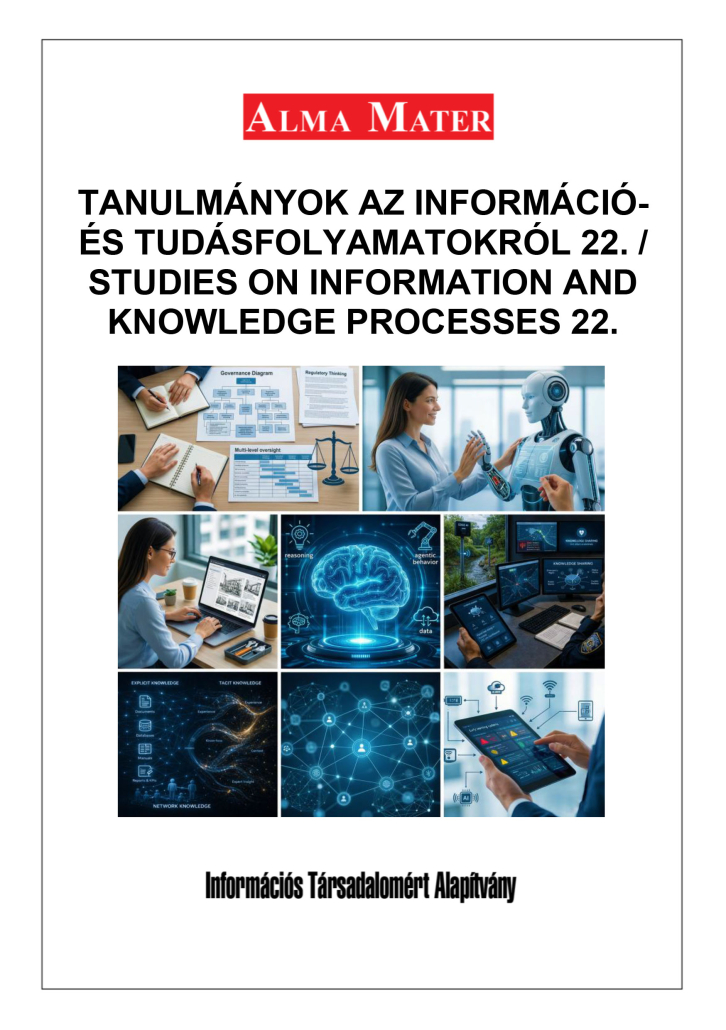

The latest volume of the Alma Mater series has been published under the title Studies on Information and Knowledge Processes 22.


The latest volume of the Alma Mater series has been published under the title Studies on Information and Knowledge Processes 22. The 190-page volume, published in December 2025, was edited by Ferenc Kiss and issued by the Information Society Foundation. As a new contribution to the Alma Mater series, the publication focuses on current theoretical and practical questions of information and knowledge management, as well as artificial intelligence.

The volume brings together studies addressing a broad range of topics, including the knowledge governance of artificial intelligence, trust and adoption of AI in business, the opportunities generative AI offers to SMEs, the implications of frontier AI for business model innovation, the relationship between policing and artificial intelligence, the links between explicit online knowledge, tacit knowledge, and AI, AI-assisted diagnosis of systemic organisational disorders and risk forecasting, and the role of hybrid intelligence and Edge AI in a new era of managerial knowledge. The collection includes both English- and Hungarian-language contributions and is available for download from the Foundation’s website.


AI Course Starts

In cooperation with Neumann János Nonprofit Public Benefit Ltd. and Neuron Solutions Ltd., we have created a practical training course for employees working in SMEs that introduces the basics of using artificial intelligence in the workplace. Registration for the first courses is now open!

(Courses run in Hungarian).
https://neum.hu/palyazati-adatlap/

Our foundation supports the 55th András Román Summer Course on Monument Protection

Infota supports the organization of the 55th András Román Summer Course on Monument Protection in Budapest, between 6-10 July, 2025.

Christmas and New Year wishes

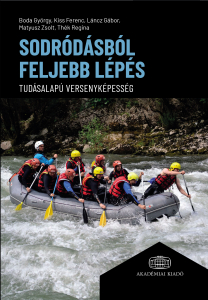
Stepping Up from Drifting – just published

Our volume summarizing the results of one of the important research projects of recent years has now been published in print, edited by Akadémiai Kiadó.

Edited by: György Boda

Akadémiai Kiadó, November 2024

ISBN: 978 963 664 051 4


Amid the pressure of the changing world economic order and the increasingly strong domestic socio-economic problems, analyses that unbiasedly and comprehensively reveal how we have exploited our opportunities so far and how we can choose a more productive path are of exceptional value.

The work of György Boda and his co-authors deserves special attention from three very important aspects, and the simultaneous validation of these aspects makes the book one of the most valuable situation-assessment readings of recent years. It acknowledges the results achieved since the change of regime, but points out why these have fallen short of expectations and possibilities. The focus of its analysis is on the real economy, the corporate sphere, but through this the effects and problems of social governance and regulation also come through. It shows what the main reasons are for the competitiveness deficiencies of companies, and how these necessarily lead to the failure of the expected macroeconomic and social convergence.

Another merit of the book is that it supports its message with very extensive statistical material, data, and calculations. It uses well-chosen databases, and handles these with demanding and mostly easy-to-follow calculation methods. It should be emphasized that while the authors use many controversial concepts in the book, they create clear situations by clearly providing their own interpretation and, where necessary, their thinking related to measurement.

A third important feature of the research is its historical and social embeddedness. It does not stop at exploring the direct causes of the phenomena, but points out the influential, often determining role of the ancient and recent past, and their interpretation. It uses statistical analysis and historical experience together to outline the possibilities for moving up from the current situation. As a conclusion, it defines the establishment of a political mechanism supporting the development and increasing the role of human capital as a fundamental condition for this move up.

Attila Chikán

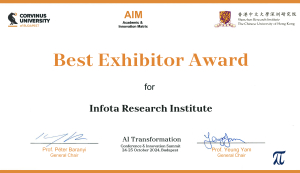
Best Exhibitor Award on Chinese – Hungarian AI Innivation Summit, 2024

Over 40 AI-focused tech exhibitors gathered at the AI Transformation Conference & Innovation Summit 2024, alongside leading Chinese and Hungarian companies, research groups, technology leaders, innovators, startup incubators, and investors from Hungary and Shenzhen. Together, they will explore collaborations and forge partnerships, driving groundbreaking projects and future business opportunities.

Our research proposal ’AI based somato mapping’ presented by Ferenc Kiss and Sándor Vincze won Best Exhibitor Award.
https://scitope.com/ait24/

Entrepreneurial thinking and creativity development workshop


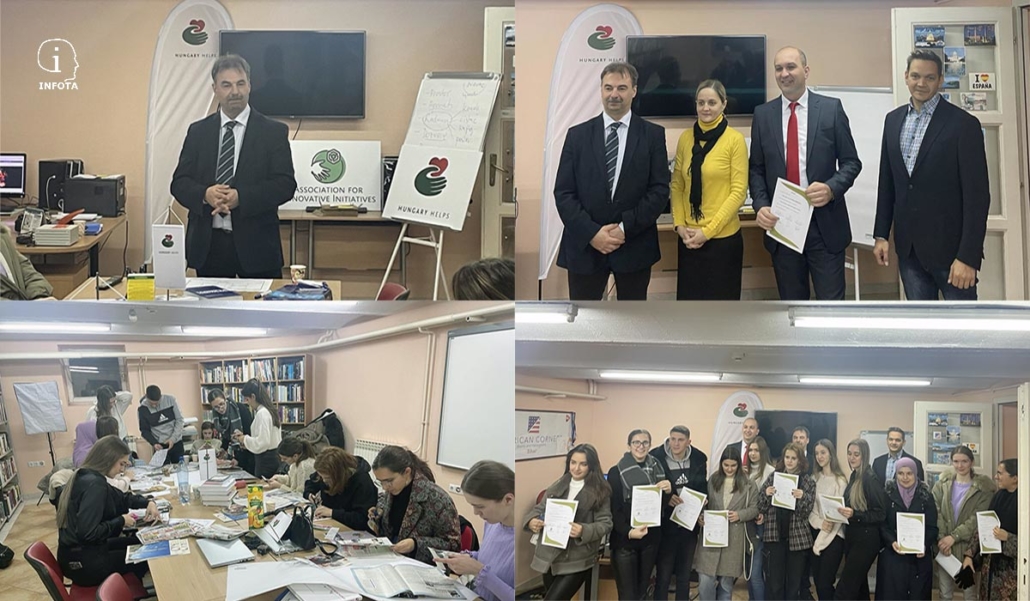
In the framework of the cooperation between the IKE2020 Innovative Initiatives Association and the Una-Sana Cantonal and University Library (Bihać, Bosnia-Herzegovina), supported by the Hungary Helps Program, on behalf of Infota, Dr Ferenc Kiss, on December 14-15, 2022, entrepreneurial thinking and creativity held a development workshop for high school and university students. The co-presenter of the course was from the University of Bihác. assoc. prof. dr. sc. Kenan Mahmutović.
In addition to on-site training, Infota also provided video and electronic learning materials for online trainings in project management and tourism fundamentals.

The summary video:


András Jávor 1937-2021

At the age of 84, our dear friend, colleague and mentor, Professor András Jávor has died.

András Jávor graduated from the Technical University of Budapest and received his M.Sc.E.E. followed by his Ph.D. degree in computer science. He received his D.Sc. from the Hungarian Academy of Sciences.

The Value of Cultural Tourism. How can we enjoy and remember our trip?

The presentation jointly prepared by dr. Lia Bassa and dr. Ferenc Kiss “The Value of Cultural Tourism. How can we enjoy and remember our trip?” was delivered at the UNESCO UNITWIN Conference in Leuven, now it is published in the proceedings:

https://ees.kuleuven.be/unitwin2019/proceedings

Learn about World Heritage by eLearning

The UNESCO World Heritage Centre and 30 member universities of the „Culture, Tourism, Development” UNITWIN Network has reported the great success of their up-to-date, high level internationally prepared eLearning material complying with all UNESCO requirements. INFOTA has also contributed to the establishment of this excellent MOOC, Tourism Management at World Heritage Sites by a chapter Technical Systems Contributing to Cultural Heritage Monitoring  written and presented by R&D Director Dr. Ferenc Kiss  and Managing Director dr. Lia Bassa.

The launching took place in January 2018., it consists of 8 modules, or chapters, opening one of them per week, so the entire course is delivered in 8 weeks. (It can be learned by your own pace, of course, by about 3 hours work invested for each lesson), and is being restarted until the end of the year. The course can be accessed: https://www.fun-mooc.fr/courses/course-v1:Paris1+16008+session01/about

If you create an account on the site and register to the MOOC, you are ready to go! If you want to receive a certificate, the next and last certificates will be issued at the end of December.

The current version operates till December 2018. Then after a little pause, MOOC Volume 2 will appear from 1 April 2019. until the end of the next year extended by 6 new chapters: Marketing Tourism (Madrid, Barcelona), Site Management System (Leuven), Loving destinations to Death (MidSweden), Behaviour and satisfaction on World Heritage Sites (Salento), Historical Memories and Tourism on WH Sites (Externado), Tourism in WH Cities (Paris). Whereas parallelly, from June 2019, MOOC Volume 1 will also be available in a rebooted, corrected version until the end of 2019.